
Pamukkale and Ephesus
Introduction
Pamukkale is a natural wonder in southwestern Turkey, famous for its white travertine terraces formed by mineral-rich thermal waters. These terraces cascade down the hillside, creating a surreal landscape that attracts tourists from around the world. Pamukkale, meaning “Cotton Castle” in Turkish, is also home to the ancient city of Hierapolis, where visitors can explore ruins like a Roman theater, ancient baths, and a necropolis. Ephesus is one of the best-preserved ancient cities in the world, located near the modern town of Selçuk in western Turkey. It was once a major Roman city and an important center of trade and religion. Key highlights include the Library of Celsus, the Great Theatre, and the Temple of Artemis, one of the Seven Wonders of the Ancient World. Ephesus offers a glimpse into the grandeur of classical antiquity.
- Introduction to Pamukkale and Ephesus
Pamukkale and Ephesus are two of Turkey’s most iconic tourist destinations, offering a combination of natural beauty and ancient history. Pamukkale, meaning “Cotton Castle,” is renowned for its white travertine terraces formed by calcium-rich thermal waters. Ephesus, on the other hand, is a remarkably well-preserved Greco-Roman city that showcases the grandeur of classical civilization. Visiting both sites provides a rich, contrasting experience of nature’s artistry and human achievement.
- Natural Wonders of Pamukkale
Pamukkale is a unique geological formation located in the Denizli Province of southwestern Turkey. Its gleaming white terraces are formed by mineral deposits left by flowing hot spring waters. Over thousands of years, calcium carbonate hardened into travertine, creating the surreal, snow-like appearance. Walking barefoot across the warm terraces and soaking in the shallow pools is a memorable experience, and it is one of the few places in the world where natural beauty and thermal health benefits come together so harmoniously.
- Hierapolis: The Ancient City Above Pamukkale
Above the travertines lies Hierapolis, an ancient Greco-Roman city that was founded as a thermal spa in the 2nd century BC. Hierapolis flourished under Roman rule and became a healing center where people came to cure their ailments using the hot springs. Today, tourists can explore a large necropolis, Roman baths, a well-preserved theater, and the Martyrium of St. Philip. The fusion of nature and archaeology makes Pamukkale-Hierapolis a UNESCO World Heritage Site.
- Pamukkale’s Cleopatra Pool
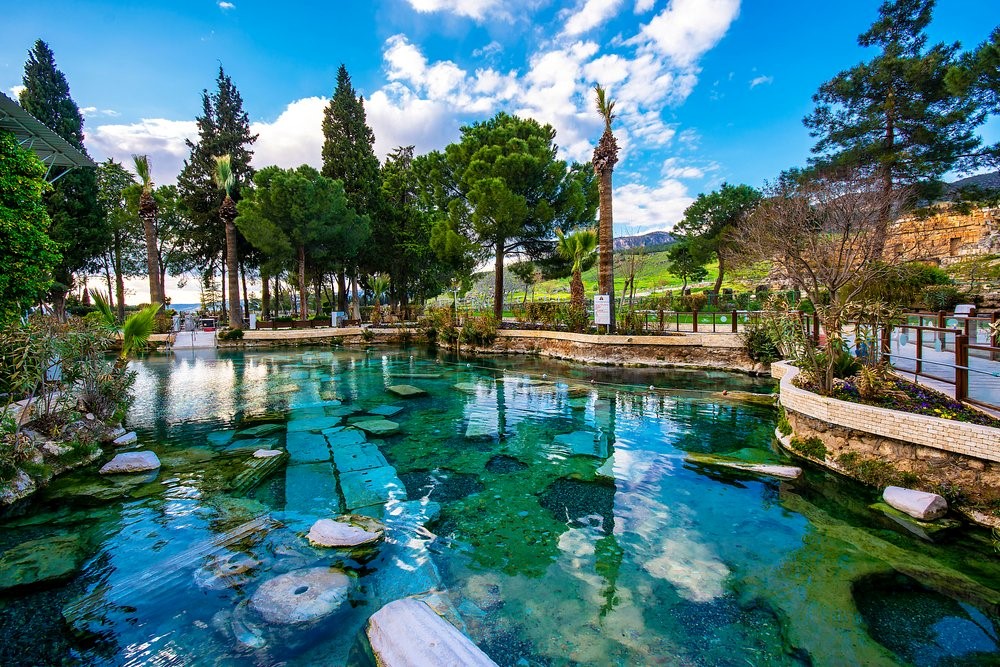
One of Pamukkale’s hidden gems is the Cleopatra Antique Pool, a man-made thermal pool where you can swim among submerged columns and marble ruins believed to have fallen during an earthquake. According to legend, Cleopatra herself once swam in these waters, which are rich in minerals like calcium, magnesium, and bicarbonate. The water maintains a soothing temperature of about 36°C (96°F), making it perfect for year-round bathing and relaxation.
- Ephesus: Gateway to the Ancient World
Located near the town of Selçuk in İzmir Province, Ephesus was one of the most important cities in the Roman Empire, serving as a key port and commercial hub. It was also a center of early Christianity and home to the Temple of Artemis—one of the Seven Wonders of the Ancient World. Wandering through its marble streets, visitors encounter impressive remains like fountains, bathhouses, temples, and theaters, offering a powerful sense of life in the ancient world.
- Highlights of Ephesus: Library of Celsus and the Great Theatre
Two of the most famous landmarks in Ephesus are the Library of Celsus and the Great Theatre. The Library, built in 117 AD, once held over 12,000 scrolls and served as a monumental tomb for Celsus, a Roman senator. Its ornate façade has been carefully reconstructed, and it is now one of the most photographed structures in the ancient world. The Great Theatre, with a seating capacity of 25,000, hosted gladiator fights, concerts, and public gatherings and still impresses with its scale and acoustics.
- Spiritual Significance of Ephesus
Ephesus holds deep religious importance, particularly in Christian tradition. It is believed to be one of the seven churches of Asia mentioned in the Book of Revelation. The House of the Virgin Mary, a nearby pilgrimage site, is traditionally considered to be the final home of Mary, mother of Jesus. The Basilica of St. John, located on the Ayasuluk Hill, was built over what is believed to be the burial site of the apostle John. These sites attract both tourists and pilgrims, making Ephesus a spiritual as well as historical destination.
- Accessibility and Visitor Experience
Both Pamukkale and Ephesus are relatively easy to access. Pamukkale is best reached from Denizli, which has a regional airport and bus connections. From Denizli, local minibuses or taxis can take you to the site. Ephesus is conveniently located near Selçuk, which is connected by rail and road to İzmir (including the international Adnan Menderes Airport). Both locations have well-developed visitor facilities, including guided tours, museums, and information centers.
- Best Time to Visit
The ideal time to visit Pamukkale and Ephesus is during spring (April–June) and autumn (September–October) when temperatures are mild and crowds are fewer. Summer can be very hot, particularly in Ephesus where the heat radiates off the stone paths. Winter, while quieter, can be chilly and may not offer the best views of the terraces, though the thermal pools remain enjoyable year-round. Early morning or late afternoon visits provide the best lighting for photography and a more peaceful atmosphere.
- Combining Pamukkale and Ephesus in a Travel Itinerary
For travelers looking to explore both sites, it’s possible to combine Pamukkale and Ephesus in a 2–3 day trip. The two locations are approximately 190 kilometers (about 3 hours by car) apart. Many organized tours cover both, or you can rent a car and enjoy the scenic Aegean countryside. Consider spending one full day in Pamukkale to explore the terraces, bathe in Cleopatra’s Pool, and visit Hierapolis. The next day, head to Selçuk for a full exploration of Ephesus and surrounding attractions such as the Temple of Artemis and the House of Virgin Mary.
Things to Do in Pamukkale
- Walk on the Travertine Terraces
The white calcium travertines are the most famous attraction in Pamukkale. You can walk barefoot on the terraces (to protect the formations) and dip your feet into the warm, mineral-rich pools. It’s both soothing and surreal, like walking on clouds.
- Swim in Cleopatra’s Antique Pool
Take a relaxing dip in the Cleopatra Pool, where warm thermal waters flow over ancient marble columns submerged from an old Roman structure. The water is believed to have healing properties, and the scenery is unique and historic.
- Explore the Ancient City of Hierapolis
Wander through the ruins of Hierapolis, a once-thriving Roman spa city. Highlights include:
- The Roman Theater, beautifully preserved with panoramic views
- The Temple of Apollo
- The Plutonium, thought to be a gate to the underworld
- The extensive necropolis (city of the dead), one of the largest in Turkey
- Visit the Hierapolis Archaeology Museum
Located in the former Roman bathhouse, this museum houses artifacts from Hierapolis and surrounding regions. You’ll find statues, sarcophagi, coins, and everyday objects from Roman and Byzantine times.
- Watch the Sunset Over the Travertines
Sunset is a magical time in Pamukkale. The golden light makes the terraces glow, reflecting stunning colors in the water. Find a quiet spot to sit and take in the peaceful scenery—it’s unforgettable.
Where to Stay in Pamukkale
- Pamukkale Town (Closest to the Travertines)
Staying in Pamukkale village offers the best convenience—you can walk to the terraces, Hierapolis, and Cleopatra’s Pool.
Recommended Hotels:
- Venus Suite Hotel (Mid-range)
A cozy, family-run hotel with a pool, good breakfast, and free shuttle service to the travertines. - Melrose Viewpoint Hotel (Budget to Mid-range)
Clean, comfortable, with a great rooftop view of the travertines and a short walk to the entrance. - Bellamaritimo Hotel (Budget)
Simple but welcoming, great for backpackers or budget travelers. Friendly hosts and good food.
- Karahayit (For Thermal Spas)
Located about 5 km from Pamukkale, Karahayit is known for its red-colored thermal springs and spa resorts.
Recommended Hotels:
- Richmond Pamukkale Thermal (Luxury)
A large thermal resort with indoor/outdoor pools, spa facilities, and wellness treatments. - Spa Hotel Colossae Thermal (Mid to Luxury)
Offers healing thermal pools, mud baths, and a quiet atmosphere outside the busy tourist zone.
- Denizli City (For More Urban Amenities)
If you want a bigger city feel, Denizli is 20–30 minutes away by car or bus. It’s ideal for travelers using trains or flights.
Recommended Hotels:
- Laodikya Hotel (Budget to Mid-range)
Central, clean, and close to the train and bus stations—good for travelers passing through. - Anya Hotel (Mid-range)
Modern rooms, good location in Denizli, and helpful staff.
Tips for Booking:
- Book early in spring and autumn—these are peak seasons.
- Look for hotels offering thermal water access or travertine views for a unique experience.
- Many Pamukkale hotels include free breakfast and shuttles to the travertines.
Day Trips from Pamukkale
- Laodicea (12 km / 15 mins)
An ancient Roman city near Denizli, Laodicea is known for its wide colonnaded streets, large theaters, and early Christian church ruins. It was one of the Seven Churches of Asia mentioned in the Book of Revelation.
- Highlights: Ancient temples, stadium, and restored arches.
- Why go: Fewer crowds than Ephesus or Hierapolis and a rich archaeological site.
- Kaklik Cave (45 km / 40 mins)
Often called the “underground Pamukkale”, Kaklik Cave features similar white travertine formations inside a large, open-roof cave with turquoise pools.
- Highlights: Thermal waters, cave formations, sulfur-rich pools.
- Why go: Off-the-beaten-path nature site with photogenic views.
- Aphrodisias (95 km / 1.5 hours)
One of Turkey’s most beautiful ancient cities, Aphrodisias was dedicated to the goddess Aphrodite and features incredibly preserved ruins.
- Highlights: The Temple of Aphrodite, massive stadium, sculptor’s workshop, and a museum filled with Greco-Roman art.
- Why go: Less touristic than Ephesus but just as stunning, with world-class ruins.
- Salda Lake (150 km / ~2.5 hours)
Known as “Turkey’s Maldives,” Salda Lake is a deep-blue volcanic lake with white magnesium-rich beaches and clear water.
- Highlights: Swimming, relaxing on white beaches, photography.
- Why go: A relaxing contrast to the ancient sites—ideal for nature lovers.
- Babadag and Paragliding from Fethiye (Optional Overnight Trip – 3 hours)
For adventure seekers, you can travel to Babadag Mountain (near Fethiye) for tandem paragliding over the turquoise coast and Oludeniz beach.
- Highlights: Epic aerial views of the Mediterranean coast.
- Why go: A thrilling experience if you want to combine history with adrenaline.