

Introduction
Crete is the largest island in Greece and one of the most historically rich regions in the Mediterranean. Located in the southern Aegean Sea, it is known as the cradle of the Minoan civilization, Europe’s earliest advanced society, which flourished around 3000–1400 BCE. The island features a diverse landscape of mountains, beaches, and fertile plains, along with ancient ruins, traditional villages, and vibrant cities like Heraklion, Chania, and Rethymno. Crete is also famous for its mythology, including the legend of the Minotaur and the Labyrinth, as well as its unique culture, cuisine, and hospitality.
- Knossos – The Legendary Minoan Palace
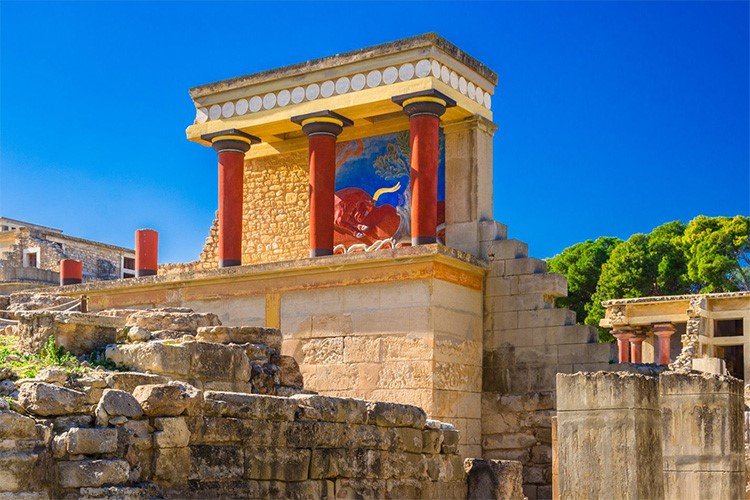
Perhaps the most iconic archaeological site on Crete, Knossos was the ceremonial and political center of the Minoan civilization. Often linked with the myth of the Minotaur, this sprawling palace complex near Heraklion covers over 20,000 square meters. Excavated by Sir Arthur Evans in the early 20th century, Knossos features multi-story buildings, grand staircases, vibrant frescoes, and advanced drainage systems. It’s believed to have housed up to 100,000 people and reveals how sophisticated Minoan society truly was.
- Phaistos – The Mysterious Disc and Bronze Age Beauty
Located in southern Crete, Phaistos is the site of another major Minoan palace, second only to Knossos in size and importance. It offers a more untouched, authentic experience, as much of it remains unaltered since excavation. Phaistos is famously associated with the Phaistos Disc, a clay object inscribed with mysterious symbols that still puzzle archaeologists. The palace overlooks the fertile Messara Plain and reflects an elegant blend of Minoan architecture and natural harmony.
- Malia – The Third Great Minoan Palace
To the east of Heraklion lies Malia, home to a lesser-known but equally significant Minoan palace. It dates back to around 1900 BCE and was likely the seat of a powerful local ruler. Malia’s palace is noted for its large courtyards, grain storage pits, and workshops, offering insight into the island’s administrative and economic life. The nearby Quartier Mu, a residential and industrial complex, reveals how everyday Minoans lived and worked.
- Zakros – The Palace by the Sea
Zakros, located on Crete’s eastern coast, is the most remote of the four major Minoan palaces. It was a key trading port with connections to Egypt and the Near East, evidenced by the luxury items found there. Unlike Knossos and Phaistos, Zakros was discovered later, in the 1960s, and is less reconstructed, making it a favorite among serious history buffs. Its seaside location adds to its unique charm and strategic importance.
- Gortyna – From Minoan Roots to Roman Grandeur
While many associate Crete with the Minoans, the island also played a crucial role in later historical periods. Gortyna, in south-central Crete, was a major Roman city that thrived after the decline of the Minoan era. Its ruins include a Roman theater, baths, and the famous Law Code of Gortyna, inscribed on a circular stone wall. This legal text, dating to the 5th century BCE, is one of the earliest known examples of Greek law and showcases the island’s continuous cultural evolution.
- Aptera – A Hilltop Fortress Overlooking the Sea
Near Chania, in western Crete, lie the ruins of Aptera, a city that dates back to the Minoan period but flourished during the Hellenistic and Roman times. Its strategic position atop a hill offered commanding views of Souda Bay. Aptera features impressive ruins, including a Roman cistern, baths, a theater, and Byzantine fortifications. The site reflects a mix of eras and is a testament to Crete’s layered history of conquests and cultures.
- Ancient Eleutherna – A City of Heroes and Graves
Not far from Rethymno, Eleutherna was a city that spanned Minoan, Greek, and Roman periods. Its ruins include necropolises, early Christian basilicas, and defensive walls. Excavations have unearthed rich burial sites, including those of warrior aristocrats, suggesting a heroic tradition akin to Homeric legends. A nearby museum showcases many of the artifacts found on-site, offering visitors a deeper understanding of the region’s long habitation.
- The Minoan Villas – Tylissos and Vathypetro
Beyond the palaces, Minoan elites also built luxurious villas, some of which survive today. Tylissos, near Heraklion, has three well-preserved Minoan houses with fresco fragments and storerooms. Another notable site is Vathypetro, where archaeologists discovered one of the world’s oldest wine presses. These villas give insight into rural life and the decentralization of Minoan political and economic systems.
- Peak Sanctuaries and Sacred Caves
The Minoans were deeply spiritual, and their religious practices are still being unraveled through ruins found on mountaintops and inside caves. Peak sanctuaries, such as Petsofas and Mount Juktas, were used for ritual activities and offerings to the gods. Meanwhile, sacred caves like Psychro (Dikteon Cave) and Idaion Antron are linked to Zeus’ birth in Greek mythology. These sites blend prehistoric worship with classical myth, showing Crete’s sacred geography.
- Cultural Significance and Ongoing Discoveries
Crete’s ancient ruins are more than just historical remnants—they are windows into the origins of European civilization. The Minoans developed advanced urban planning, art, trade networks, and religious practices that influenced later Greek culture. Excavations continue to reveal new findings, and sites like Knossos are continually reinterpreted, as new evidence becomes known. Crete’s ruins are part of a broader Mediterranean story, linking civilizations from Egypt to Mycenaean Greece.
Where to stay in Crete
- Heraklion (Iraklio) – Best for History & Central Access
Ideal for: First-time visitors, culture lovers, museumgoers
- Home to the Palace of Knossos, Heraklion Archaeological Museum, and a vibrant harbor.
- Central location for exploring both eastern and western Crete.
- Best for short stays or travelers who want quick access to major ruins and the airport.
Top hotel picks:
- GDM Megaron – Luxury with harbor views
- Lato Boutique Hotel – Great value and central
- Chania – Best for Charm, Beaches & Old Town Vibes
Ideal for: Couples, families, photographers
- Famous for its Venetian Harbor, narrow streets, and romantic atmosphere.
- Access to some of the island’s best beaches like Elafonissi, Balos, and Falassarna.
- Rich mix of restaurants, boutique hotels, and traditional tavernas.
Top hotel picks:
- Casa Delfino Hotel & Spa – Boutique in the old town
- Ambassadors Residence – Stylish and right on the harbor
- Rethymno – Best for a Balanced Stay (History + Beach)
Ideal for: Families, relaxed travelers, mid-budget tourists
- A mix of Venetian, Ottoman, and Greek architecture.
- Has a beautiful old town, a long sandy beach, and nearby countryside villages.
- Quieter than Heraklion and Chania but still offers plenty of culture and charm.
Top hotel picks:
- Avli Lounge Apartments – Romantic and unique
- Rimondi Boutique Hotel – Elegant and centrally located
Things to do in Crete
- Explore the Palace of Knossos
- Visit the center of the Minoan civilization, just outside Heraklion.
- Walk through ancient throne rooms, colorful frescoes, and storied ruins.
- Linked to the myth of the Minotaur and King Minos.
- Relax on Elafonissi Beach
- Famous for its pink sand and shallow turquoise waters.
- Ideal for families and photographers.
- Located in southwestern Crete – worth the drive for a full-day trip.
- Hike the Samaria Gorge
- One of Europe’s longest gorges (16 km).
- Trek from the Omalos Plateau to the Libyan Sea.
- Best done May–October; wear proper hiking shoes!
Day trip from Crete
- Spinalonga Island (from Elounda or Agios Nikolaos)
Type: Historical / Boat trip
- Visit the former Venetian fortress turned leper colony, rich in tragic history and panoramic views.
- Short boat ride (10–30 mins) from Elounda or Plaka.
- Combine with a visit to the beautiful Kolokitha Beach or lunch in seaside tavernas.
Half-day trip | Eastern Crete
- Balos Lagoon & Gramvousa Island (from Kissamos or Chania)
Type: Beach / Nature / Boat tour
- A stunning blue lagoon with white sands, considered one of the most beautiful beaches in Europe.
- Includes a stop at Gramvousa Island with its cliff-top Venetian fortress.
- Go by boat from Kissamos port, or hike from the Balos parking area (challenging!).
Full-day trip | Western Crete
- Samaria Gorge Hike (from Chania or Rethymno)
Type: Adventure / Hiking
- Europe’s longest gorge (16 km), surrounded by dramatic cliffs and pine forests.
- Hike ends at the Libyan Sea, with a ferry ride to Chora Sfakion, then bus back.
- Challenging but rewarding—bring good shoes, water, and start early!
Full-day trip (10–12 hrs) | Southwest Crete